Too Many Apps, Not Enough Finance
Why the mid-market CFO office is buckling under its own tech stack — and what the next five years will change
The modern mid-market CFO office is a control tower built on duct tape. Not because the team is incompetent — because the stack exploded and nobody was steering.
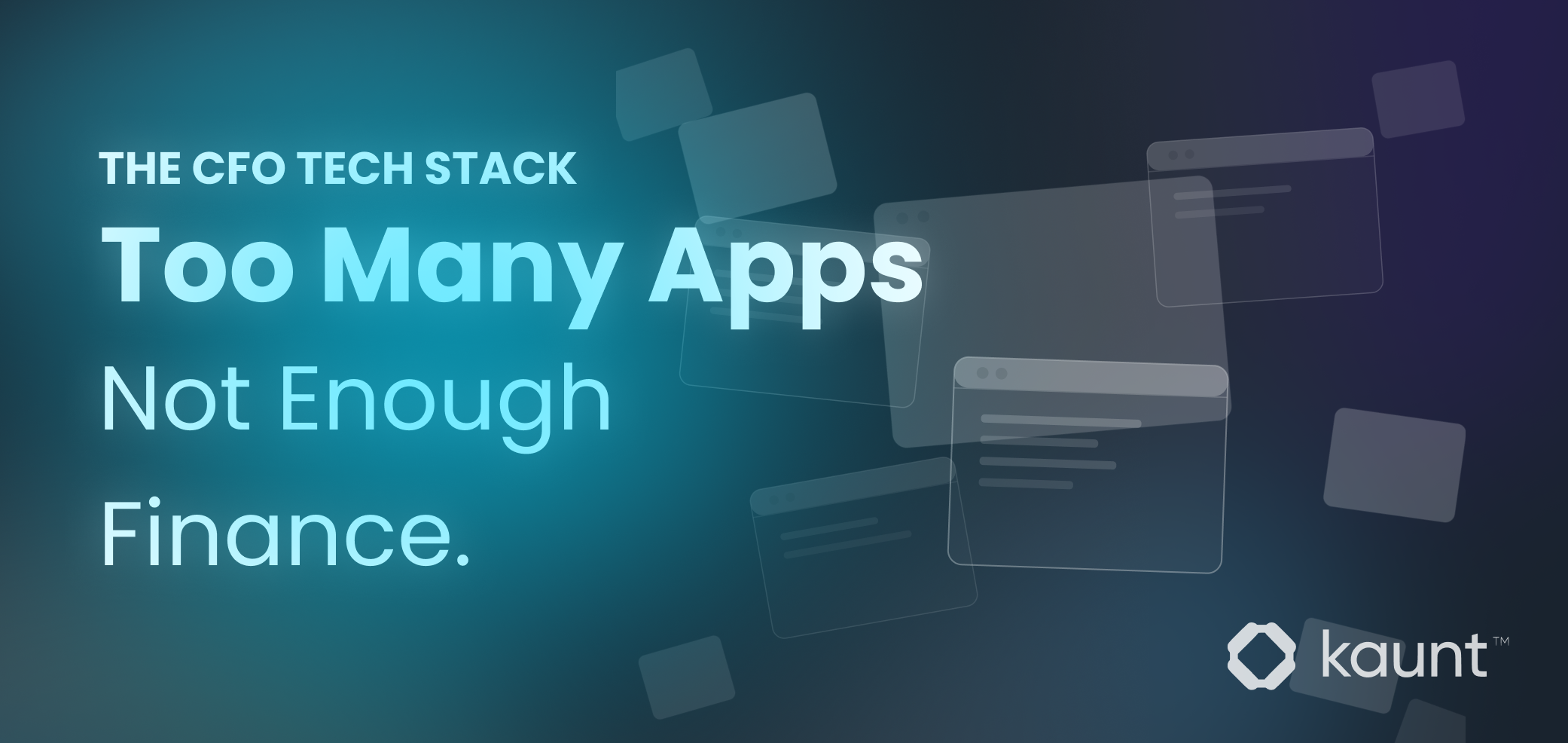
Accounting. AP automation. Payroll. Expenses. FP&A. Revenue recognition. Tax. BI. Each tool was bought for a real reason. Together they created a bigger problem: complexity compounding faster than headcount, and a finance function that spends more time feeding the machine than running the business.
This is the central paradox of mid-market finance tech in 2026: best-of-breed tools are better than ever, and the total system is harder than ever to run. QuickBooks promotes 800+ integrations. Xero celebrated 1,000 connected apps. From the CFO’s chair, that’s 1,000 reconciliation surfaces, data model mismatches, and failure modes. The CFO office has become the integration layer — manually, by default.
The Fragmentation Tax
The numbers frame the damage clearly: the average mid-market finance team runs 8–15 separate applications. Finance professionals spend a median 39% of their time on manual, automatable tasks — the equivalent of three full-time roles in an eight-person team doing nothing but moving data. Month-end close takes 10–20 business days, most of it data assembly rather than analysis. AFP’s 2025 FP&A benchmarking survey found 96% of teams still use spreadsheets for planning and 93% for daily reporting, despite owning dedicated tools. The spreadsheet is not the enemy. It is the symptom — proof that the stack still doesn’t give finance a unified, trustworthy layer for analysis.
Why the Stack Became a Mess — and Why It Was Rational
Before diagnosing the problem, it’s worth acknowledging that every buying decision that created this mess was reasonable. Finance teams didn’t sleepwalk into complexity. Point solutions implemented faster, delivered clearer ROI, and actually worked — unlike the ERP module that was “good enough” only on a slide deck. The problem was never that finance teams bought the wrong tools. It’s that nobody designed what happens when you run all of them simultaneously.
Integration is the #1 hidden tax
Every application added to the stack doesn’t just add a capability — it adds a data model to normalize, a permissions layer to maintain, a reconciliation surface to manage, and a failure mode to own. A 2025 SMB research report found integration of applications is a top operational challenge for finance functions, with financial services firms among those struggling most. This is not a configuration problem. It is structural.
Product owners are solving the wrong problem
The instinct of most finance platform teams is to expand: add features, absorb adjacent workflows, become the platform. But this assumes the problem is a missing feature. It isn’t. Every finance platform — including the best ones — is still an island. Adding AP features to an FP&A tool doesn’t solve fragmentation; it creates a new island with slightly more landmass. The CFO still builds the bridges. The right question isn’t “what can we add?” — it’s “how do we stop being one more thing to integrate?”
Three Ways Complexity Is Quietly Destroying Finance Performance
1. Operational drag that never shows up in the software budget
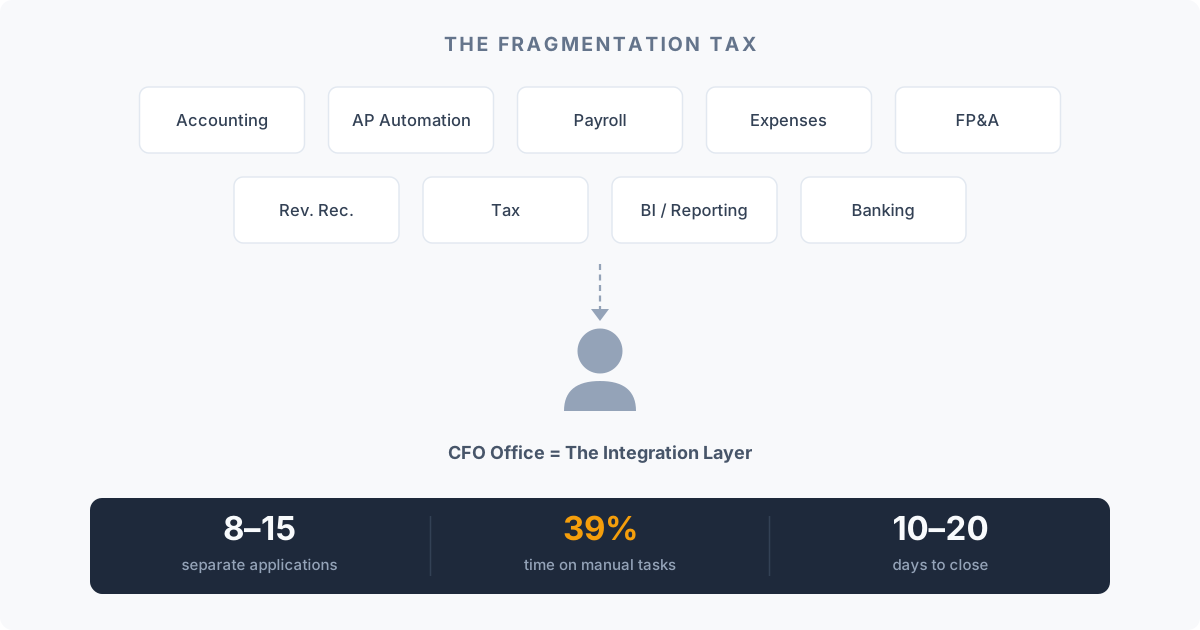
A 39% manual overhead doesn’t appear as a line item. It appears as a close that takes three weeks instead of five days, as “why doesn’t this match?” firefighting every Monday, as exports and imports and mappings that everyone accepts as just the job. For a team of eight, that’s three people doing nothing but moving data. Not a productivity problem — a structural failure hidden inside a headcount model. And it compounds: 50–70% of close time is data assembly, not analysis. Sophisticated tools get used at 20–30% of their actual capability because the overhead of using them correctly is too high.
2. Compliance risk: quiet, but real
As the toolchain grows, so does its compliance shadow. Inconsistent approval paths proliferate when different spend types live in different systems. Audit trails fragment — reconstructing a decision becomes archaeological. Access creep sets in silently: ex-employees retain permissions in systems never connected to offboarding. Shadow finance operations migrate to inboxes and spreadsheets. None of this is dramatic. It accumulates slowly — and surfaces in an audit, a board question, or an acquisition due diligence at exactly the wrong moment.
3. Talent friction that compounds over time
Mid-market companies can’t afford a finance systems team, so the CFO office becomes one. Senior finance professionals burn hours onboarding hires across 8–15 tools, maintaining institutional knowledge, and troubleshooting integrations that have no clear owner. The people hired to drive forecasting accuracy and strategic decisions are operating as de facto IT support. This is also a retention problem: finance professionals who want intelligent work don’t stay long where the job is fundamentally babysitting a broken data pipeline.
The Finance Stack in Five Years: Not Fewer Apps — Less Felt Complexity
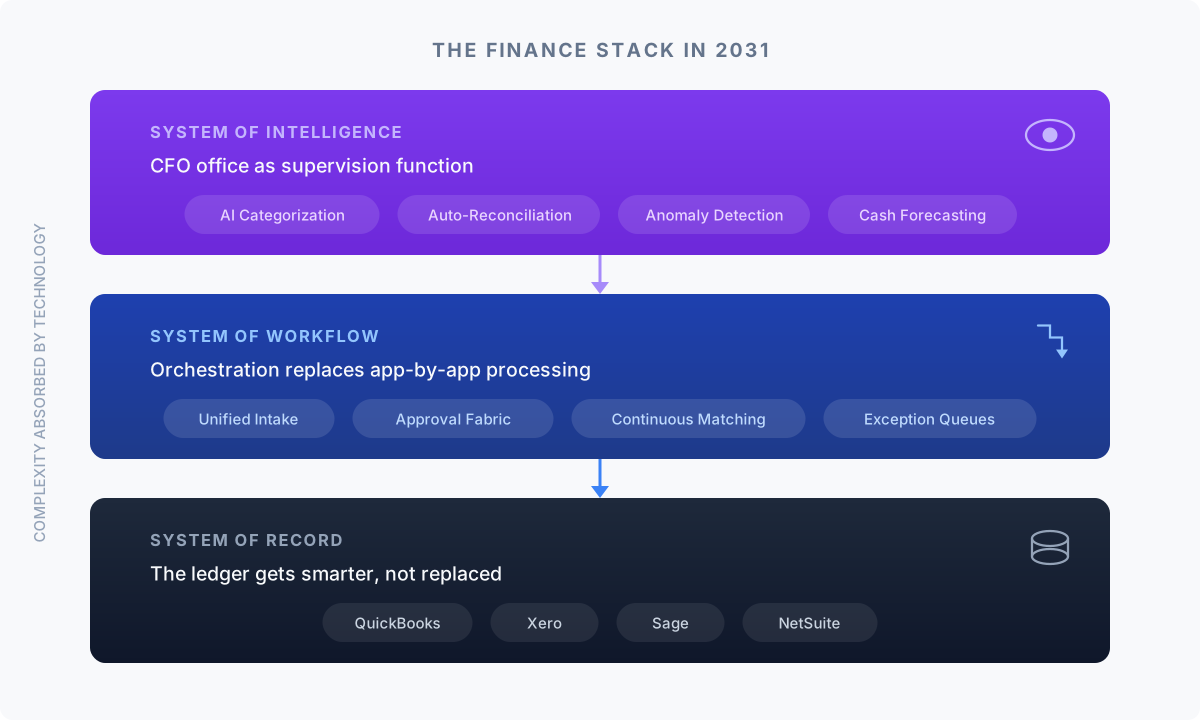
The future CFO office doesn’t necessarily run fewer applications. It runs a fundamentally different architecture — one where complexity is absorbed by an intelligence layer rather than delegated to the finance team. That layer has three components already emerging, and will be table stakes by 2031.
System of Record: the ledger gets smarter, not replaced
The accounting core — QuickBooks, Xero, Sage, NetSuite — doesn’t disappear. But it stops being a passive repository. It evolves toward real-time posting, event-driven journal creation, and clean APIs that let downstream intelligence act on financial data without human mediation. The close stops being an event and becomes a state.
System of Workflow: orchestration replaces app-by-app processing
Unified intake across invoices, receipts, POs, contracts, and bank feeds. A single approval fabric spanning cards, invoices, payroll adjustments, and subscriptions. Continuous matching replaces the monthly sprint. Exception queues replace manual processing queues. Fewer human handoffs, more end-to-end flow — the CFO stops being the integration layer because the workflow layer handles it.
System of Intelligence: the CFO office becomes a supervision function
This is where the most significant transformation happens. AI agents handle transaction categorization, reconciliation, variance analysis, and cash forecasting autonomously. Anomaly detection flags duplicate payments, vendor drift, and margin leakage before they surface in a board report. Board-pack narratives are drafted from actual variances and sent for human review, not human creation.
“Agentic” finance — when it’s real and not hype — means the team shifts from operators to supervisors: maintaining policy, reviewing exceptions, driving decisions. This is not distant. Intuit has already committed to this direction with a reported $100M+ multi-year partnership to embed OpenAI models across QuickBooks. The consolidation mechanism isn’t a mega-suite — it’s embedded partnerships and shared data contracts, with commerce, banking, payroll, AP, and forecasting snapping together so the CFO experiences it as one system.
What “Good” Looks Like in 2031
If the stack evolves correctly:
• Continuous close replaces month-end panic — the ledger is always current, always auditable
• Exception-first workflows replace manual processing — humans review, not execute
• One approval fabric spans every spend type: invoice, card, payroll, subscription
• One cash truth merges bank reality, open commitments, and rolling forecast
• Auditability is automatic — every action carries a trace and a rationale
• Spreadsheets are for modeling, not for data plumbing
The finance team’s job shifts from “process and reconcile” to “maintain policy, oversee exceptions, and drive decisions.” That is not incremental improvement. That is a fundamentally different role — and a fundamentally different product requirement.
The Kaunt Approach: Intelligence That Meets Finance Where It Already Is
Most responses to the fragmentation problem follow one of two playbooks: build a new super-platform that absorbs everything, or build better integrations between existing tools. Neither works at scale. The super-platform creates a new consolidation risk. Better integrations are a permanent maintenance burden that grows with every new app in the stack.
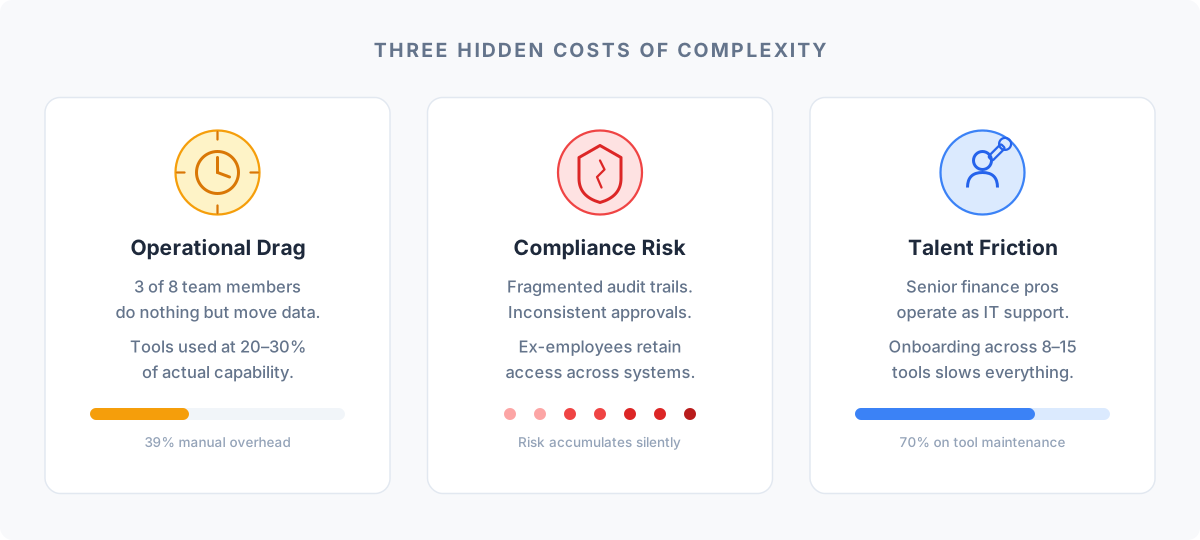
Kaunt is built on a different premise: don’t ask finance teams to change where they work. Change what their tools can do.
Rather than adding another application to the stack, Kaunt embeds advanced AI capabilities directly into the platforms mid-market teams already rely on. The ERP that required manual journal entries now suggests them with explainability. The FP&A platform that needed an analyst to build scenarios now generates rolling forecasts from live operational signals. The AP system that flagged duplicates now predicts payment timing and surfaces cash optimization opportunities before the CFO asks.
This matters for a precise reason: adoption. When intelligence is embedded into an existing workflow, it’s not a change management project — finance teams don’t learn a new tool, their current tools simply become dramatically more useful. The best predictor of AI adoption in finance isn’t feature richness. It’s workflow friction. Kaunt eliminates the friction by embedding AI where the work already happens.
For product owners, this is a decisive strategic choice. Build AI features in isolation — a chatbot here, an anomaly detector there — and watch them fail because they sit outside the workflows finance teams trust. Or embed an intelligence infrastructure that makes your platform the most capable version of itself, without asking customers to change a single habit.
The mid-market CFO office doesn’t need more applications. It needs the ones it already depends on to become dramatically more intelligent. The platforms that win the next decade will be the ones that made that possible.
That is the transformation Kaunt is driving — from inside the platforms finance already uses.