
Stop Buying AI Features. Start Buying Reduction of Operational Complexity.
The most valuable AI in finance is the kind users barely notice — and it is not what most companies are buying.

A year ago, most conversations around AI in finance were about capabilities.
Could AI code invoices?
Could it automate approvals?
Could it act like a copilot?
Could users "chat" with their financial systems?
Recently, I was asked what has changed most since then.
The biggest shift is not model quality. The models have improved, but that is not what is reshaping the conversation.
The biggest shift is that many companies are slowly realizing they are optimizing for the wrong thing.
Companies should stop buying AI features.
They should start buying reduction of operational complexity.
That sounds like a small reframe. It is not. It changes which products win, which architectures matter, and what finance teams should expect from the next five years of investment in this space.
The First Wave Was About Visibility
The first wave of enterprise AI focused on making AI visible.
- Copilots
- Chat interfaces
- AI sidebars
- Prompt boxes
- "Talk to your ERP"
- Generative assistants bolted onto every screen
Some of these interfaces are genuinely useful. There are workflows where conversation is the right answer — open-ended analysis, ad-hoc reporting, exploring unfamiliar data. In those contexts, visibility is the product.
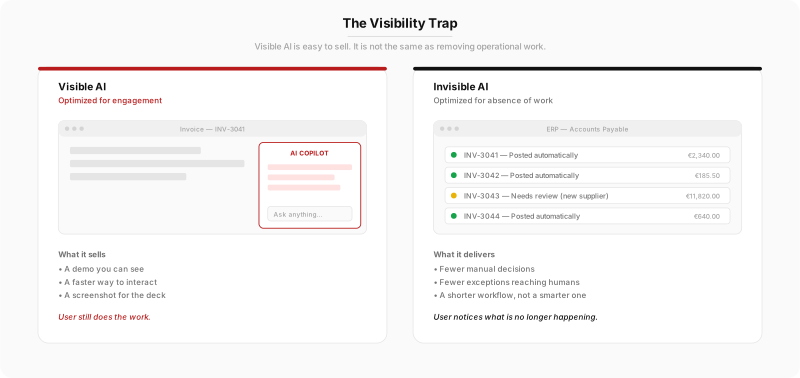
But in operational finance workflows, visibility is not the same as value. A copilot that helps an accountant reason about an invoice is still an accountant reasoning about an invoice. The work did not disappear. It got a better assistant.
Better assistants are nice. They are not what most finance teams are actually trying to buy.
Finance Teams Are Asking a Different Question
Most finance teams are not asking:
"How can I interact more with AI?"
They are asking:
- How do we reduce manual decisions?
- How do we reduce exceptions?
- How do we reduce operational overhead?
- How do we reduce workflow friction?
- How do we make the process disappear unless attention is actually needed?
That is a fundamentally different optimization target.
A copilot answers the first question. It gives the user a better way to interact. The other five are not about interaction at all — they are about removing the need for interaction in the first place.
A finance team running 50,000 invoices per quarter does not want a chat interface for those invoices. They want most of those invoices to flow through without anyone needing to think about them. The chat interface, however good, is solving the wrong problem at scale.
This is the gap between the AI features being marketed and the AI value being demanded.
The AI You Barely Notice
The most valuable AI systems in finance are the ones users barely notice.
Not because they are weak. Because they quietly handle:
- Classification
- Enrichment
- Validation
- Routing
- Grouping
- Exception detection
- Policy checks
before anyone is asked to make a decision.
The goal is not to make users "chat through AP workflows." The goal is to remove unnecessary operational work entirely. Two very different products. Two very different architectures.
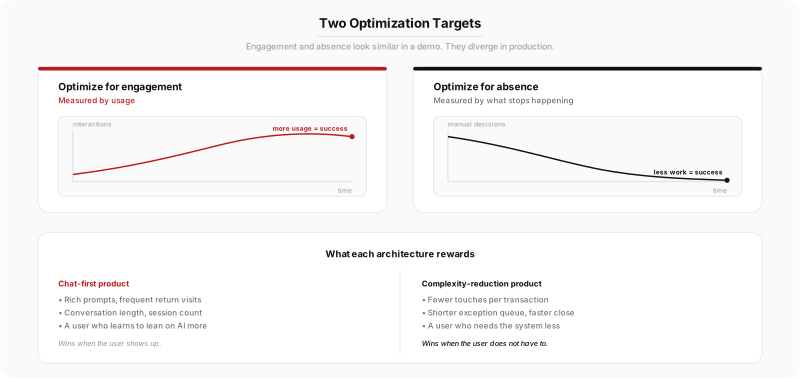
A chat-first product optimizes for engagement: how often does the user come back, how rich are the prompts, how good is the conversation. An operational-complexity product optimizes for the opposite: how rarely does the user need to engage at all, and when they do, how decisive can the interaction be.
The first is measured by usage. The second is measured by absence.
A Concrete Example
Consider what this looks like for a single category of work — supplier invoices arriving by email.
A capability-led product:
The accountant opens an inbox. The AI offers a summary of each invoice. There is a chat interface where the user can ask "what is this charge?" or "is this in line with our policy?" The AI helps the accountant work through each invoice faster. Throughput improves. The accountant still classifies, validates, routes, and posts every transaction. The interface is smarter. The work surface is the same.
A complexity-reduction product:
The invoice arrives. Before anyone sees it, the system classifies the line items against the customer's chart of accounts, checks the supplier against contract terms, validates VAT against the jurisdiction matrix, identifies the cost center, runs policy checks, and matches against open POs. If everything is consistent and confidence is high, the transaction is prepared and posted. The accountant never sees it.
If something is genuinely uncertain — a new supplier category, a policy edge case, an amount above threshold — the transaction is surfaced with full context: what was decided, where uncertainty arose, what alternatives were considered, what the reviewer needs to confirm. A five-second decision.
Both products use AI. Only the second one reduces operational complexity. And only the second one will scale to the volumes that actually matter to a CFO.
ERP Stays. Its Role Shifts.
This also changes how to think about ERP systems.
ERP remains essential, because it acts as the system of record:
- Auditability
- Compliance
- Accountability
- Traceability
That has not changed and will not change. The regulatory and audit functions of ERP are not negotiable, and no chat interface or AI assistant replaces them.
But the role of ERP interaction is changing.
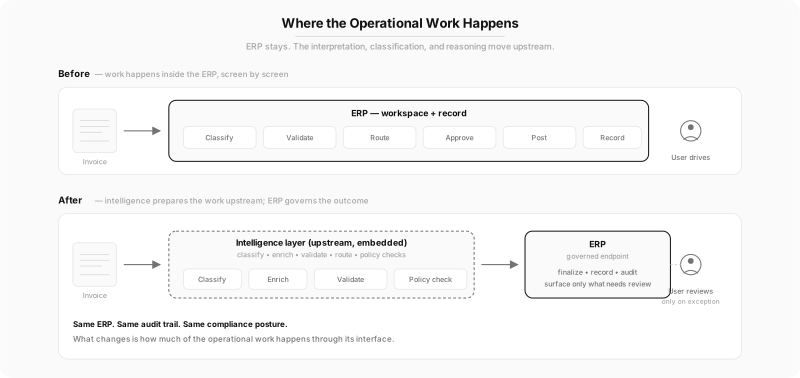
Historically, ERP was where work happened. Where users operated processes. Where decisions were manually constructed, screen by screen, click by click.
Increasingly, AI handles much of the preparation and reasoning before anything reaches the ERP. The ERP becomes the governed endpoint — the place where transactions are validated, finalized, and recorded with a full audit trail. But less of the actual operational work needs to happen through its interface.
That intelligence sits embedded inside the ERP experience, not bolted on next to it. The user opens the same system they have always used. The audit trail is the same. The compliance posture is the same. The transaction is just already mostly done by the time anyone has to look at it.
Why Vendors Default to the Visible Path
If complexity reduction is the higher-value target, why are most vendors selling visibility?
Because visibility is easier to sell, easier to demo, and easier to build.
A copilot demos beautifully. You open a screen, type a question, and a confident answer appears. Everyone in the room can see the AI working. The procurement team has something tangible to point to in the contract. The vendor has a screenshot for the deck.
Complexity reduction is the opposite. The product's success is invisible by design. There is nothing to demo, because the most valuable transactions are the ones nobody had to look at. The work that did not happen does not show up in a screenshot. The clearest evidence is six months of operational data showing fewer manual decisions, fewer exceptions, shorter close cycles — none of which fits in a sales motion.
Building it is also harder. A chat interface needs a model and a prompt. A complexity-reduction system needs accurate per-customer classification, calibrated confidence, policy enforcement, exception design, and integration with the system of record. Most of that work is not glamorous and none of it is visible to the user when it succeeds.
The result is a market full of products optimized for what is easy to sell and short of products optimized for what is most valuable to operate. Buyers who understand the difference can take advantage of that gap. Vendors who keep optimizing the demo will eventually find themselves selling against the operational data of vendors who did not.
Removing Interfaces, Not Adding Them
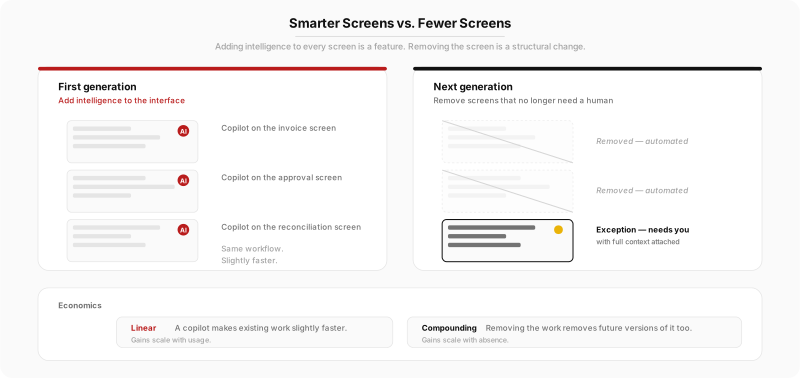
The first generation of AI in enterprise software focused on adding intelligence to the interface. Smarter dropdowns, better autocomplete, helpful summaries, copilots in every corner of every screen.
The next generation will focus on removing unnecessary interfaces altogether.
That sounds like a smaller ambition. It is a much larger one. Adding a copilot to a screen is a feature. Removing the screen — because the underlying work no longer requires human construction — is a structural change to how a finance team operates.
It also has very different economics. A copilot makes existing work slightly faster. An operational-complexity product makes existing work disappear. The first is linear. The second compounds.
The companies that recognize this will buy differently. They will stop evaluating AI products by the cleverness of their interface and start evaluating them by how much operational work has been removed three months after deployment. That is a much harder metric for most vendors to defend, which is exactly why it is the right one.
What This Means for How Companies Buy
If the goal is reducing operational complexity rather than acquiring AI features, the buying conversation should change in concrete ways.
Stop asking: Does it have a chat interface? Does it have a copilot? Can it summarize?
Start asking:
- How many manual decisions disappear after this is deployed?
- How many exceptions does it actually resolve, and how many does it just route somewhere else?
- What does the user do less of after six months of use?
- Where does the workflow get shorter, not just smarter?
- What does the audit trail look like for the work the user no longer touches?
These are harder questions. They require evidence, not demos. A copilot demos beautifully. A reduction in operational complexity is invisible by definition — you have to look at what is not happening anymore.
Vendors that lead with feature lists are usually answering the wrong question. Vendors that lead with reductions in workflow steps, exception volume, and manual interventions are answering the right one. The difference is visible in how they describe their own product.
What Success Will Look Like
Over time, the most successful AI systems in finance will not feel like "AI products" at all.
They will not have a brand-defining chat box. They will not be the place users go to "do AI things." They will not show up as a separate icon on the desktop or a new tab in the browser.
They will simply feel like operations happening automatically.
Invoices arrive coded. Exceptions surface with context. Period-end shrinks. The team handles more volume with less effort. The interface they sit in front of is the one they were already using. The intelligence is somewhere upstream, doing its work without asking for attention.
That is not a less ambitious vision of AI in finance. It is a more ambitious one. It is the difference between a product that helps a person do a job and a product that quietly makes parts of the job stop existing.
The first is a feature. The second is a structural improvement to how finance functions are run.
The companies that internalize this distinction — both as buyers and as builders — will define the next chapter. Everyone else will keep adding chat boxes to screens that should not need to exist in the first place.
