
ERP Is Strong at Recording Truth, Weak at Creating It
AI won't replace ERP. But it's automating the layer where financial truth is actually constructed
The AI-will-replace-ERP thesis is everywhere. Venture capital funds it. LinkedIn celebrates it. Conference talks dissect it. And it is almost entirely wrong — but not for the reason most people think.
The conventional counterargument goes something like this: ERPs are entrenched, too valuable, migration costs too high. All true. All also missing the point. The real reason AI will not replace ERP has nothing to do with switching costs or lock-in. It is about category error. ERP exists to do one specific thing, and AI exists to do something almost entirely different. We have confused the two, so we have confused the future.
The real story is not about ERP being replaced. It is about ERP finally being paired with what it was always missing.
ERP Does Not Exist to "Do Work"
This is the foundational misunderstanding. When people say "ERP systems run finance," they are technically correct but spiritually wrong. ERP does not run finance. ERP records finance. There is a profound difference.
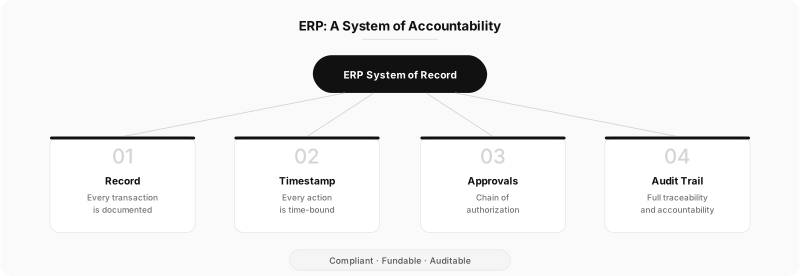
Every transaction in an ERP has a timestamp, an audit trail, approvals, an owner, and an immutable record. That is not a business system. That is an accountability system. It is institutional memory. It exists so that six months from now, when an auditor asks "Why did we record this transaction?" someone can produce a timestamped, signed chain of evidence that answers the question.
Why this matters beyond compliance
When you post a journal entry in SAP or NetSuite, you are not just moving numbers. You are creating a fact that exists forever — one that can be audited, traced back through approvals, used in a lawsuit, used in M&A due diligence, or used to satisfy regulators years later. This is the difference between "we did this" and "we can prove we did this." For any business with external stakeholders — investors, creditors, partners, acquirers — that proof is existential.
The M&A context makes this concrete. When a company gets acquired, the first thing the buyer's accountants ask about is the quality of the accounting system itself. Can we trust these numbers? Where is the audit trail? A company with chaotic accounting and manual workarounds does not just cost more to acquire — it becomes un-acquirable. The ERP is what makes a company fundable, credible, and provable.
Consider what happens without one. A company running finance on spreadsheets and email chains has zero ability to scale. Every transaction is a potential problem. Every close cycle is a nightmare. Every audit is adversarial. There is no immutable record, so there is no truth — only "what people remember." The ERP solved a fundamental problem: it made finance provable. That problem does not go away.
But Something Is Missing
Here is the insight that changes everything. Storing truth perfectly and creating truth correctly are two completely different activities. ERP systems are extraordinarily good at the first. They are mediocre at the second. And the second is where the actual work happens.
The journey of a single invoice
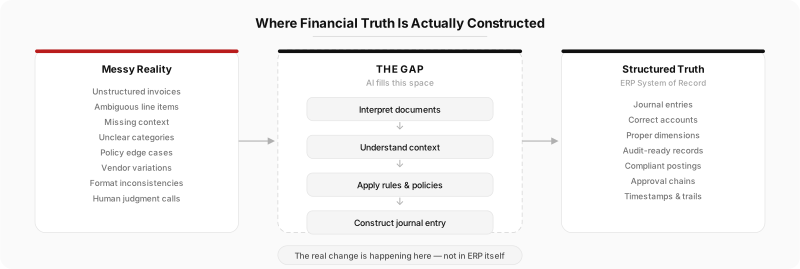
An invoice arrives as a PDF from a vendor. Unstructured. Messy. Possibly scanned multiple times. The accountant now makes a series of decisions. Is this a legitimate invoice from a legitimate vendor? What was actually ordered — and does the invoice match the purchase order? How should the line items be classified when the vendor's grouping does not match the chart of accounts? At what amount, given foreign currency, payment terms, and possible discounts? Are there policy implications — spending limits, approval thresholds, capitalization rules?
By the time that invoice is structured as a journal entry and posted to the ERP, dozens of decisions have been made. And here is the crucial part: those decisions are what creates financial truth. The ERP does not make those decisions. The accountant does. The ERP just records the outcome.
Now multiply that across a company. Thousands of invoices. Thousands of decisions being made by different people, at different times, with different levels of understanding. The quality of your financial statements depends entirely on the quality of those upstream decisions. Two accountants given the same invoice might classify it differently. The same accountant on Monday and Friday might classify it differently. That is the gap. ERP excels at governance once a decision has been made. It is terrible at making the decision in the first place.
ERP Is Not Built for Ambiguity
This gap exists for a fundamental reason: ERP systems are designed around certainty, not ambiguity. They expect structured inputs, known fields, predefined logic. If you want to post a journal entry, you provide an account code, an amount, a description. The system validates and posts. This works perfectly when the input is already structured. It breaks down when the input is ambiguous — and almost all of the interesting work in accounting is handling ambiguity.
The messy reality of inputs
Vendors do not submit invoices in standardized formats. The same vendor might use ten different invoice layouts. Vendor names change through acquisitions. A company called "ABC Supplies Inc" gets bought and becomes "XYZ Corp d/b/a ABC Supplies" — but the PO was against the old name. Invoice amounts rarely match POs exactly: discounts, freight charges, errors. The ERP can enforce a tolerance policy, but it cannot handle the edge cases that fall outside it for legitimate business reasons.
Consider a $15,000 invoice for "consulting services rendered in connection with regulatory affairs." The PO was for $20,000, written six months ago. Is this a partial invoice? What was actually delivered? The scope descriptions are vague and do not map directly. Should this be coded to regulatory affairs, legal, or a specific project? The decision affects cost attribution — and therefore strategy. The ERP does not care about any of this. It just wants: account code, amount, date.
This is why so much finance work happens before, around, or outside ERP. Spreadsheets become the real system of record for complex scenarios. Email becomes the decision-making engine. Institutional knowledge fills the gap. Not because ERP is bad — but because it was never designed to derive truth from ambiguity.
The Hidden Cost of the Gap
The gap between messy reality and structured ERP creates four compounding costs that almost no one measures directly.
Labor and speed
Finance professionals spend 30–40% of their time on data preparation: interpreting invoices, matching documents, coding transactions. A controller earning $200,000 per year is burning $70,000 annually on work that produces no insights. Multiply across a team of 20 and the cost is staggering. Meanwhile, month-end close takes two weeks — not because the ledger is slow, but because reconciling upstream errors is slow. If the decisions going in were higher quality, the close would be faster.
Consistency and talent
Different people code transactions differently. One accountant interprets ambiguity conservatively, another liberally. Over time, this creates drift — catch-all accounts, inconsistent cost attribution, noise in reporting. Management asks "why is spending up 15%?" and the answer is partly bad coding, not real variance. Meanwhile, the most senior people in finance — hired for judgment and strategic thinking — are spending their days on data prep. The entire function is constrained by the need to feed the ERP rather than understand the business.
This Is Where AI Changes Things
Now the question reframes. Not "Will AI replace ERP?" but "Can AI fill the gap?" The answer is yes — but not by becoming a new ERP. AI becomes the decision layer that ERP never was.
What this looks like concretely
An invoice arrives as a PDF. The AI extracts vendor name, date, line items, amounts — even from poorly scanned or rotated images. But extraction is just step one.
Classification comes next. "Supplies purchased" could be office supplies (account 6100), computer equipment (6200), or facilities (6300). The AI looks at the description, the vendor's history, similar line items, and produces a probabilistic classification: 87% office supplies, 10% facilities, 3% other. This is what AI is good at — pattern matching, learning from historical data, assigning confidence scores.
Then validation. Is the amount reasonable for that category? Does the classification match the purchase order? If the AI finds mismatches, it does not post anyway. It asks the human to review: "This invoice is 10x the normal amount from this vendor. Should someone take a look?"
Then matching. The PO was for $20,000, the invoice is $19,500. An ERP would reject the mismatch. A human would accept it as a discount. The AI can learn to do this too, with a confidence score attached. Then currency conversion, policy application, intercompany handling — all the judgment calls that ERPs struggle with because they expect pre-structured inputs.
None of this replaces the ERP. The ERP still records the final transaction, creates the audit trail, enforces controls. What is happening is that the upstream decision layer is being automated — and because it is AI, it can handle ambiguity, learn from patterns, and improve over time.
The Shift Is Subtle — but Fundamental
Consider a parallel from software architecture. When databases were invented, people asked: "Will databases replace application logic?" What actually happened was separation of concerns. The application layer handled decisions and transformations. The database layer handled persistence and durability. Neither replaced the other. Both got better because they specialized.
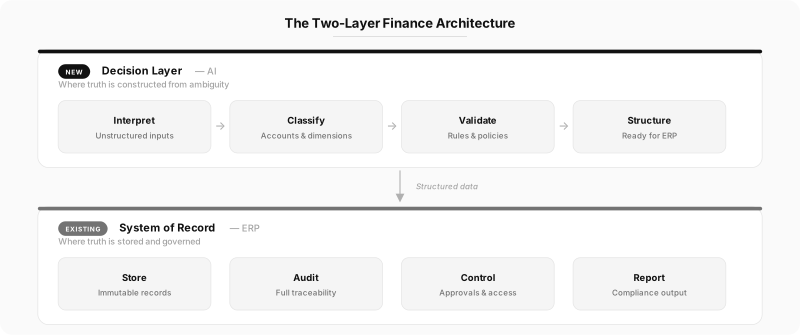
The same thing is happening with ERP and AI. For decades, ERP was asked to do two things: store financial truth and help construct it. It was always excellent at the first and mediocre at the second. Now we are seeing specialization. ERP becomes pure system of record — immutable, auditable, governed, deterministic. AI becomes the decision layer — contextual, learning, probabilistic, adaptive.
For the first time, we can build a two-layer architecture where each layer does what it is actually good at. Neither is trying to be both. Neither is compromised by trying to do the other's job. And because they are separated, they can both be better. This is why the "AI replaces ERP" question is fundamentally misconceived. They are not in competition. They are components in a larger system.
What This Means in Practice
The new workflow
In the old world, an invoice hits a person's inbox and sits there until someone has time to process it — 15 to 30 minutes of cognitive work per invoice. In the two-layer world, it hits the decision layer. The AI extracts, classifies, matches, validates, and produces a structured proposal: "Here is what I think should be recorded. Here are my confidence scores. Here are the things that look unusual." The human reviews. In 80–90% of cases, they approve in seconds. In the rest, they correct and teach. Then the structured, reviewed transaction goes to the ERP.
The shift is profound but it is not about replacing people. It is about changing what people do. Instead of making raw decisions from scratch, they are supervising AI decisions. Instead of remembering rules, they are refining rules. Instead of processing, they are reviewing. The accountant moves from "processor" to "reviewer and refiner."
The economic impact
Expand this across all transaction types — vendor invoices, credit cards, payroll, intercompany, expense reports — and the economics change fundamentally. Speed improves: the close compresses from weeks to days because transactions are higher quality going in. Consistency improves: the AI applies rules uniformly. Scalability improves: volume growth no longer requires proportional headcount growth. And financial statement quality improves because they are built from higher-quality decisions. A perfectly maintained ledger full of incorrectly classified transactions is worse than useless. It is confidently wrong. The two-layer architecture solves that — not by making the ledger better, but by making the decisions upstream of the ledger better.
What This Means for ERP Vendors
The strongest ERPs will be those that fully embrace being the best system of record while opening cleanly to external intelligence. This means better APIs — most ERPs are still designed for human UI interaction, not machine-to-machine integration. It means clearer data models — transparent validation logic so external systems know exactly what the ERP expects. And it means discipline about separation of concerns.
The risk for ERP vendors is trying to own the decision layer themselves. Building tightly coupled AI features sounds logical, but produces capabilities bound to one platform's data model. The decision layer needs to work across the messy multi-vendor reality of actual enterprises — multiple ERPs, multiple finance systems, multiple sources of truth. The vendors who will win are those who are excellent at their core job and open to what they do not do.
What This Means for Finance Teams
There is real fear around AI and finance. Will it take my job? The honest answer: some jobs will change. But the direction is elevation, not elimination.
How the role changes
Today, accountants spend much of their day on transaction processing — reading invoices, coding them, entering them. With the decision layer, they review AI proposals instead. Most can be approved in seconds. Unusual cases require judgment and teach the system. The freed-up time goes to what accountants should have been doing all along: understanding what the data means, explaining variances, building forecasts, analyzing trends.
There is also new work: refining the rules. As the AI processes transactions, its rules need maintenance. If the classification policy changes, someone updates the decision layer. This is interesting work — formalizing implicit knowledge, requiring both business understanding and analytical thinking.
Hiring and career implications
The junior accountant role shifts from data entry to working with the AI — reviewing output, refining rules. That requires different skills: not just "can you follow procedures" but "can you understand why a procedure exists and improve it?" The controller role becomes more interesting and more important — owning not just the system of record but the quality of decisions upstream. The best controllers will be those who understand finance deeply and know how to teach machines to make financial decisions.
A Better Way to Think About It
Instead of asking "Will AI replace ERP?" — ask: "Where is financial truth actually constructed?" Not recorded. Constructed. A raw event happens. Someone interprets it, classifies it, validates it against policy. Only then does the ERP record it. The decision happens upstream. That upstream process has been the bottleneck for decades.
AI fills that gap. Not perfectly. Not without human judgment. But systematically, at scale, in a way humans alone cannot. The ERP remains unchanged — still the system of record, still enforcing controls, still creating accountability. What changes is what feeds into it. The question is not whether ERP survives. It will. The question is who builds the intelligence layer in front of it — and whether that layer earns the trust of finance teams who have spent their careers doing this work themselves.
Final Thought
ERP systems solved a problem that was nearly intractable before they existed: making financial transactions trustworthy, permanent, and auditable. That achievement is permanent.
But ERP was never designed to create financial truth in the first place — to interpret messy events and decide how they should be recorded. That job has been done by accountants with spreadsheets, email, and tribal knowledge. It has been slow, inconsistent, and expensive.
AI fills that gap. Not by replacing ERP, but by giving it what it always needed: a decision layer that matches the complexity of the real world. The architecture of finance is not changing because ERP failed. It is changing because we finally have technology capable of doing the work that ERP was never meant to do.
